Tribute to Zaha
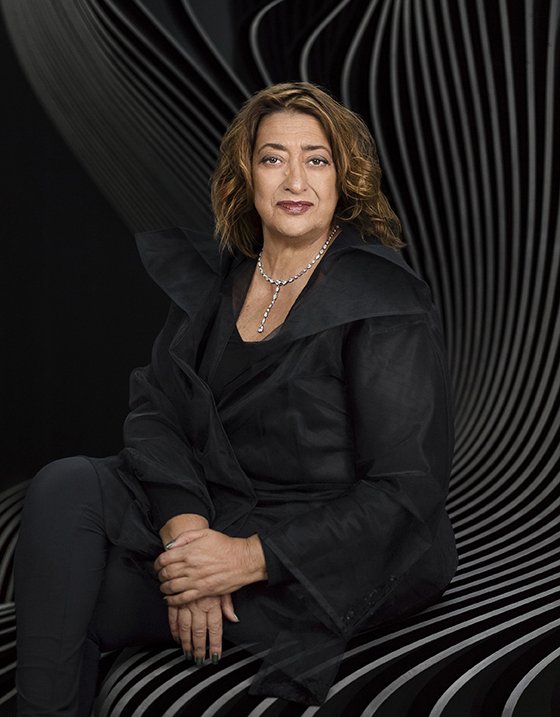
Dame Zaha Mohammad Hadid, DBE (Arabic: زها حديد Zahā Ḥadīd; 31 October 1950 – 31 March 2016) was an Iraqi architect. She was the first woman and the first Muslim to receive the Pritzker Architecture Prize, winning it in 2004. She received the Stirling Prizein 2010 and 2011. In 2012, she was created a Dame Commander of the Order of the British Empire and in 2015 she became the first woman to be awarded the RIBA Gold Medal in her own right.[1]
Hadid liberated architectural geometry[2] with the creation of highly expressive, sweeping fluid forms of multiple perspective points and fragmented geometry that evoke the chaos and flux of modern life.[3] A pioneer of parametricism, and an icon ofneo-futurism, with a formidable personality, her acclaimed work and ground-breaking forms include the aquatic center for the London 2012 Olympics, the Broad Art Museumin the U.S., and the Guangzhou, China opera house.[4]
On 31 March 2016, Hadid died of a heart attack in a Miami hospital, where she was being treated for bronchitis.[5][6]
http://www.zaha-hadid.com/
BMW Central Building © CNN from Zaha Hadid Architects on Vimeo.
Venice Biennale Theme ‘Common Ground’ Zaha Hadid Architects from Zaha Hadid Architects on Vimeo.
Born in Baghdad Iraq in 1950, Zaha Hadid commenced her college studies at the American University in Beirut, in the field of mathematics. She moved to London in 1972 to study architecture at the Architectural Association and upon graduation in 1977, she joined the Office of Metropolitan Architecture (OMA). She also taught at the Architectural Association (AA) with OMA collaborators Rem Koolhaas and Elia Zenghelis.
She began her own practice in London in 1980 and won the prestigious competition for the Hong Kong Peak Club, a leisure and recreational center in 1983. Painting and drawing, especially in her early period, are important techniques of investigation for her design work. Ever since her 1983 retrospective exhibition at the AA in London, her architecture has been shown in exhibitions worldwide and many of her works are held in important museum collections.
Known as an architect who consistently pushes the boundaries of architecture and urban design, her work experiments with new spatial concepts intensifying existing urban landscapes and encompassing all fields of design, from the urban scale to interiors and furniture.
She is well-known for some of her seminal built works, such at the Vitra Fire Station (1993), Weil am Rhein, Germany, the Mind Zone at the Millennium Dome (1999) Greenwich, UK, a ski jump (2002) in Innsbruck, Austria and the Rosenthal Center for Contemporary Art (2003) in Cincinnati, Ohio. Parallel with her private practice, Hadid has continued to be involved in academics, holding chairs and guest professorships at Harvard University, Yale University, the University of Illinois at Chicago, Columbia University, the University of Visual Arts in Hamburg and the University of Applied Arts in Vienna.
Sleuk Rith Institute Cambodia from Zaha Hadid Architects on Vimeo.
Parametric Space - teaser from Kollision on Vimeo.
Zaha Hadid Architects [http://www.zaha-hadid.com] are working with design office Kollision [http://kollision.dk], CAVI [http://cavi.au.dk] and Wahlberg [http://www.wahlberg.dk] to create the interactive installation 'Parametric Space' for the exhibition 'Zaha Hadid - World Architecture' at the Danish Architecture Centre [http://www.dac.dk] 29 June - 29 September 2013. The installation is a fully parametric space that will react on visitors movements - in shape and expression.
The exhibition has been developed by Zaha Hadid Architects in collaboration with the Danish Architecture Centre, supported by Realdania and Kvadrat.
See the final installation here: https://vimeo.com/69356542
For more information see kollision.dk/en/parametric
Furthermore see the following link for more media architecture projects from Kollision: vimeo.com/album/1809263
Cincinnati Arts Centre © Zaha Hadid Architects from Zaha Hadid Architects on Vimeo.
Mathematics Gallery at the Science Museum, London from Zaha Hadid Architects on Vimeo.
New National Stadium Video Presentation from Zaha Hadid Architects on Vimeo.
Zaha Hadid Architects welcomes a new bidding process for the New National Stadium in order to reduce costs and ensure value for money in terms of quality, durability and long-term sustainability. This video presentation and report outlines in detail the unique design for the New National Stadium which has been thoughtfully developed over two years to be the most compact and efficient stadium for this very special location in Tokyo.
Designed by Zaha Hadid Architects and our Japanese partners, the New National Stadium contains all the knowledge and expertise gained from the team’s direct experience of other Olympic, World Cup and World Championship stadia. The substantial investment in time, effort and resources already made by the Government and people of Japan into the existing team over the past two years ensures the New National Stadium can be completed in time to welcome the world to Japan in 2019 ahead of the Tokyo 2020 Olympic and Paralympic Games, and become a new home for sport for many future generations of Japan’s athletes, sportsmen and women.
Global Cities at the Tate Modern © Zaha Hadid Architects from Zaha Hadid Architects on Vimeo.
Inside the Eli and Edythe Broad Art Museum at Michigan State University from Zaha Hadid Architects on Vimeo.
Michigan State University's Eli and Edythe Broad Art Museum opened at MSU on November 10, 2012. Here's MSU University Advancement's sneak peak look inside at the November 9 media preview.
JS Bach / Zaha Hadid Architects Music Hall © Zaha Hadid Architects from Zaha Hadid Architects on Vimeo.
Edifici Torre Espiral © Zaha Hadid Architects from Zaha Hadid Architects on Vimeo.
Spittelau Viaducts Housing Project © Zaha Hadid Architects from Zaha Hadid Architects on Vimeo.
Salerno Maritime Terminal © Zaha Hadid Architects from Zaha Hadid Architects on Vimeo.
Habitable Bridge over the River Thames © Zaha Hadid Architects from Zaha Hadid Architects on Vimeo.
Z-Car © Zaha Hadid Architects from Zaha Hadid Architects on Vimeo.
Essay
The Architecture of Zaha Hadid
By Joseph Giovannini
Architect and Critic
By Joseph Giovannini
Architect and Critic
"Very few buildings can stand up to the Alps without retreating into modesty, but Zaha Hadid’s dynamic and lyrical Bergisel Ski Jump in Innsbruck, Austria, completed in 2002, confronts the surrounding mountains with an equivalent architectural majesty. At the top of a hill, the structure occupies the sky, a free-standing silhouette. Within the bowl of a valley ringed by hills and vertiginous mountains, the turning form of the clubhouse seems to gather and funnel the aerial energy of the mountainscape to the long, bowed ramp that lofts jumpers toward the city below. Hadid designed the sweeping structure from top to bottom as one fluid gesture that both summarizes the surrounding landscape in a sweep of movement, and sends skiers down a jump conceived in an act of fluid geometric empathy akin to flight.As in Michelangelo’s Sistine Ceiling, where God nearly touches Adam’s hand to spark life, Hadid has provided the index finger that makes a visual connection between the sky and the ground. Here the spark of life is completed in the jump. The sensuous forms visualize and poeticize the leap, spiraling the mountainscape, sky and ground into a fluid continuum.
Air is Hadid’s element: she floats buildings that reside aloft. At a time, in the early 1980s, when architects were concerned about manifesting the path of gravity through buildings, Hadid invented a new anti-gravitational visual physics. She suspended weight in the same way dramatists suspend disbelief. In 1983, she won a much-published international competition for a sports club on the Peak above Hong Kong with a crystalline structure that seemed to explode from the mountainside, creating in the fragmentary fall-out a structure that evaded any sense of a unitary whole. Eruption rather than gravity was the defining force directing the path of a building that thrived in the air. Floor planes were no longer extruded up from a single foundation, stacked atop one another, but beamed out in different directions, shifting as they rose in a complex section. A highway curved through the building in the space between the splayed, airborne volumes.
Historically, the proposal broke new ground in the field, and did so radically. As original to architecture as the twelve-tone scale once was to music, the design represented architecture of a wholly different and very unexpected order. Whatever the metaphor—explosion, implosion, fragmentation—the design favored open forms rather than closed, hermetic volumes; it offered breathing porosity rather than sealed fortification. The design quickly proved a foundational thesis for architecture, an unexpected precedent for shifting Modernism’s paradigm from simplicity to complexity. The theory behind the building moved away from modernism’s ideas of mass production, received typologies and the normative, to a more complex order of a kind that privileged the unique and the fragmentary. The scheme signaled a shift in sensibilities not only from truisms of the past but also from set tenets of industrial modernism, toward an indeterminate complexity sited on shifting ground somewhere between order and chaos.
In the 1980s, many people mistakenly believed that the Peak was influenced by the use of the computer. But the influence was historical, and in the context of the Pritzker Prize, awarded this year in St. Petersburg, coincidental. The imperial Russian capital was the seat of the Russian Avant-Garde artists who inspired Hadid very early in her career.
Vladimir Malevich, who pursued a mystic fourth dimension in his paintings and architectural schemes, had studied here, and he and his pupil El Lissitzky embarked on a remarkable journey into spatial mystery in the 1910s and ’20s. Their promising experiments were aborted by a Soviet state that adopted Soviet Realism in art as official policy, and a bombastic version of classicism in architecture.The flame of discovery went out for decades.
In the 1970s, however, Hadid, a student at the Architectural Association in London, took Malevich’s abstract compositions and, giving them scale and function, turned them into architectural projects that gave life again to the vision. Courageously she set off on a course to realize ideas, such as fragmentation and layering, never built by the Suprematists themselves. Inspired by Malevich’s ethereal paintings, she took up the brush as a design tool, and for her, painted tableaux became a locus of spatial invention. With this methodology, applied in the elusive pursuit of almost intangible form, she escaped the prejudice latent in such design tools as the T-square and parallel rule, traditionally used by architects. Hadid came off the drawing boards, much as Frank Gehry did when, influenced by artists, he left behind the usual drawings to conceive his buildings sculpturally, often with his hands. Hadid abandoned the regularity of the T-square and parallel rule in buildings emancipated from the right angle..."
http://www.pritzkerprize.com/sites/default/files/file_fields/field_files_inline/2004_essay_0.pdf
About Us - Zaha Hadid Architects from Zaha Hadid Architects on Vimeo.
Madrid Civil Courts of Justice © Zaha Hadid Architects from Zaha Hadid Architects on Vimeo.
(CNN) Frank Gehry: "She was a great architect and a great friend. I will miss her."
Richard Rogers: "Zaha Hadid was a radical genius -- an architect far ahead of her time. I loved Zaha and will miss her"
Norman Foster: "I think it was Zaha's triumph to go beyond the beautiful graphic visions of her sculptural approach to architecture into reality that so upset some of her critics. She was an individual of great courage, conviction and tenacity. It is rare to find these qualities tied to a free creative spirit. That is why her loss is so profound and her example so inspirational. And, besides, she was my dear friend."
A tribute to Zaha Hadid RA: 1950–2016
By RA Architecture
Published 31 March 2016
One of the world’s greatest architects, Zaha Hadid inspired a generation. Following the sad news of her death, the RA’s Head of Architecture and two fellow architects reflect on a visionary career.
No comments:
Post a Comment